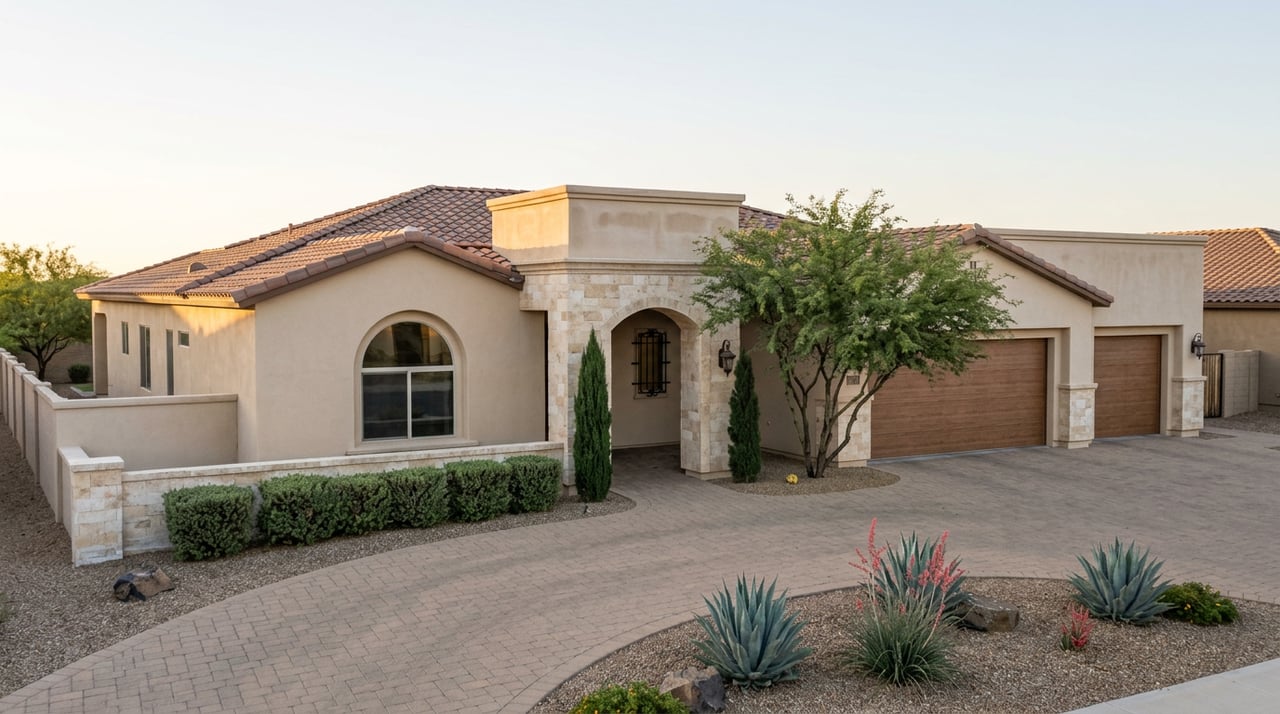
An appraiser pulls into a half-acre lot off Lone Mountain Road, tape measure in hand, and starts looking for comps. JVM Lending describes standard practice as using comps within about a mile and within twenty percent of the subject's square footage. Sales that closed in the last ninety days are also used. On a tract street in Summerlin or Aliante, that search takes minutes. Five matching roofs sit within a few blocks.
Here, the appraiser has to keep driving. The horse-zoned parcel with a barn in back doesn't compare to the stucco two-story across the street, and the stucco two-story doesn't compare to the gated custom estate two turns away. Underwriting guidelines let appraisers widen the search when nearby comps are scarce, which is exactly the situation on Lone Mountain's rural-zoned streets, where a barn and a subdivision roofline can share a fence line.
That's the thing about Lone Mountain nobody tells you when you're scrolling listings. The median price you see quoted for the neighborhood isn't describing one market. It's describing several distinct markets, stacked on top of each other, on the same roads, in the same zip code.
Several Markets Wearing One Zip Code
As of June 2026, homes for sale in Lone Mountain ranged from $325,000 to $4,750,000, with a median around $460,000 and an average sale price of $527,754. That gap between median and average is the tell. A median describes the middle of a sorted list. An average that runs $67,000 higher means a handful of high-value sales are pulling the number up, and in Lone Mountain, those high-value sales aren't outliers. They're a whole separate product line.
Break it down by section and the picture gets clearer. The area's own market reporting splits it into named pieces: the broader Lone Mountain community resells between $400,000 and $725,000, while neighboring Painted Mountain runs $425,000 to $675,000. Those numbers describe standard tract-built streets, the kind you'll find in Durango Hills or Cimarron Village, with HOAs, sidewalks, and comps a block away. Horse Property Zone parcels, sitting on Rural Estate zoning with half-acre-plus lots, run $500,000 to $600,000, often with no HOA at all. Lone Mountain Heights view lots land at $550,000 to $700,000. And custom equestrian estates on an acre or more start around $600,000 and climb past $900,000.
Then there's another tier that doesn't show up in a simple zip-code average unless you know to look for it. The Estates at Lone Mountain, a gated community built by Templeton Development Corp on one-acre and three-quarter-acre lots, carries a minimal $180 a month HOA and no special improvement or lighting district assessments. Developer Kris Templeton told the Las Vegas Review-Journal his finished one-acre lots were running about $1.35 million an acre, roughly half what comparable luxury communities elsewhere in the valley charge for the same land. That single project alone can account for home sales stretching into the millions, sitting a short drive from a $425,000 house in Painted Mountain.
Where the Line Actually Falls
The reason these tiers sit so close together isn't random. It's zoning, and it's older than most of the subdivisions built around it.
Rural Estate zoning, the designation covering most of Lone Mountain's horse-friendly parcels, sets rules for horse-keeping and lot subdivision. On top of that sits a Rural Neighborhood Preservation overlay, a designation that limits density to keep the semi-rural character intact.
Here's the part that catches buyers off guard: not every rural-zoned street has that RNP protection. Some parcels were absorbed into standard subdivisions during past building booms. Where a rural street butts up against a busier road, a buffer zone provision allows increased density subject to development conditions. That's a meaningful density increase, and it's the kind of detail a listing sheet won't spell out. If you're buying next to open desert on a rural-zoned street, whether that view stays open is a zoning question, not an assumption.
Why the Appraisal Gets Harder, Not Just the Search
This is where the zoning patchwork turns into a real transaction problem.
Appraisal convention leans on comps within about a mile of the subject property and within twenty percent of its square footage, using sales that closed recently. Fannie Mae doesn't set a hard distance cap, though, and appraisers are expected to look farther when nearby comps genuinely don't exist, a situation that same lending guidance calls routine for rural properties. Lone Mountain, despite sitting inside city limits with Durango Hills Golf Club and MountainView Hospital just a few miles off, produces exactly that situation on its horse-zoned and custom-estate streets.
A tract home in Durango Hills has plenty of company for a same-street, same-square-footage comp. A one-acre custom estate at The Estates at Lone Mountain doesn't. The appraiser assigned to that file has to reach across the neighborhood, sometimes across the zip code, to find another one-acre gated lot that closed recently, and if the market's thin that quarter, the file may lean on sales that aren't quite the right vintage or finish level. That's how a well-negotiated contract on a custom estate ends up with an appraisal that comes in under the agreed price, not because the home isn't worth it, but because the standard comp radius wasn't built for a neighborhood with several distinct products on one map.
Meanwhile, the ZIP 89129 area, which covers Lone Mountain, saw its median sold price soften about 8 percent year over year through mid-2026, with recent closings clearing around $257 a square foot. That figure is useful context for a standard subdivision resale. It tells you almost nothing about what a half-acre horse property or a gated one-acre estate should appraise for, because those sales aren't in the pool that produced the number.
What This Means If You're Buying or Selling Here
If you're on either side of a Lone Mountain contract, a few things follow directly from this.
- Know which market tier your property actually belongs to before you anchor to a number you saw online. A zip-code median or a portal-style average blends product types that don't share comps, so it won't tell you what your specific home or lot should sell for.
- If you're buying or selling a horse-zoned or custom-estate property, ask your agent to confirm the appraiser assigned to the file has experience with rural or acreage properties in this specific submarket, not just Las Vegas tract housing broadly.
- Verify the zoning and any RNP status on the parcel directly with Clark County before you write an offer, especially if an open lot or dirt road view is part of what you're paying for. Zoning designations can change or vary parcel by parcel, and what's true for the house three doors down isn't guaranteed for yours.
- Build in time. A wider comp search takes longer than a standard appraisal, and if you're on a tight closing timeline for a PCS move or a competing offer, that extra week matters.
None of this means Lone Mountain is a harder place to transact. It means it's a neighborhood where the map matters more than the median, and where the right guidance before you write an offer saves you a renegotiation after the appraisal lands.
A Few Questions Worth Asking Directly
Does every part of Lone Mountain allow horses? No. Rural Estate zoning generally allows horse-keeping, but that designation doesn't cover every parcel in the neighborhood, and some older rural lots have been absorbed into standard subdivisions over the years. Verify zoning on the specific parcel rather than assuming based on the surrounding area.
Is every custom-estate section in Lone Mountain HOA-free? No. The Estates at Lone Mountain carries a $180 monthly HOA that covers landscaping and the trail system around the homes, while some older rural parcels outside that development have no HOA at all. HOA status has to be checked property by property.
Why would two homes with similar square footage appraise so differently here? Because square footage alone doesn't determine the comp pool. A subdivision home draws on dozens of nearby sales. A horse property or gated custom estate draws on a much smaller, more scattered set, and the appraiser's search radius reflects that scarcity rather than a flaw in either home.
If you're weighing a move into Lone Mountain, or you're already here and thinking about what your specific property is actually worth against the right comps, Dan Merrill can walk through which of these distinct markets your address falls into and what that means for your timeline. Let's Connect.
This article is general information, not legal, tax or financial advice. Consult a qualified professional about your situation.